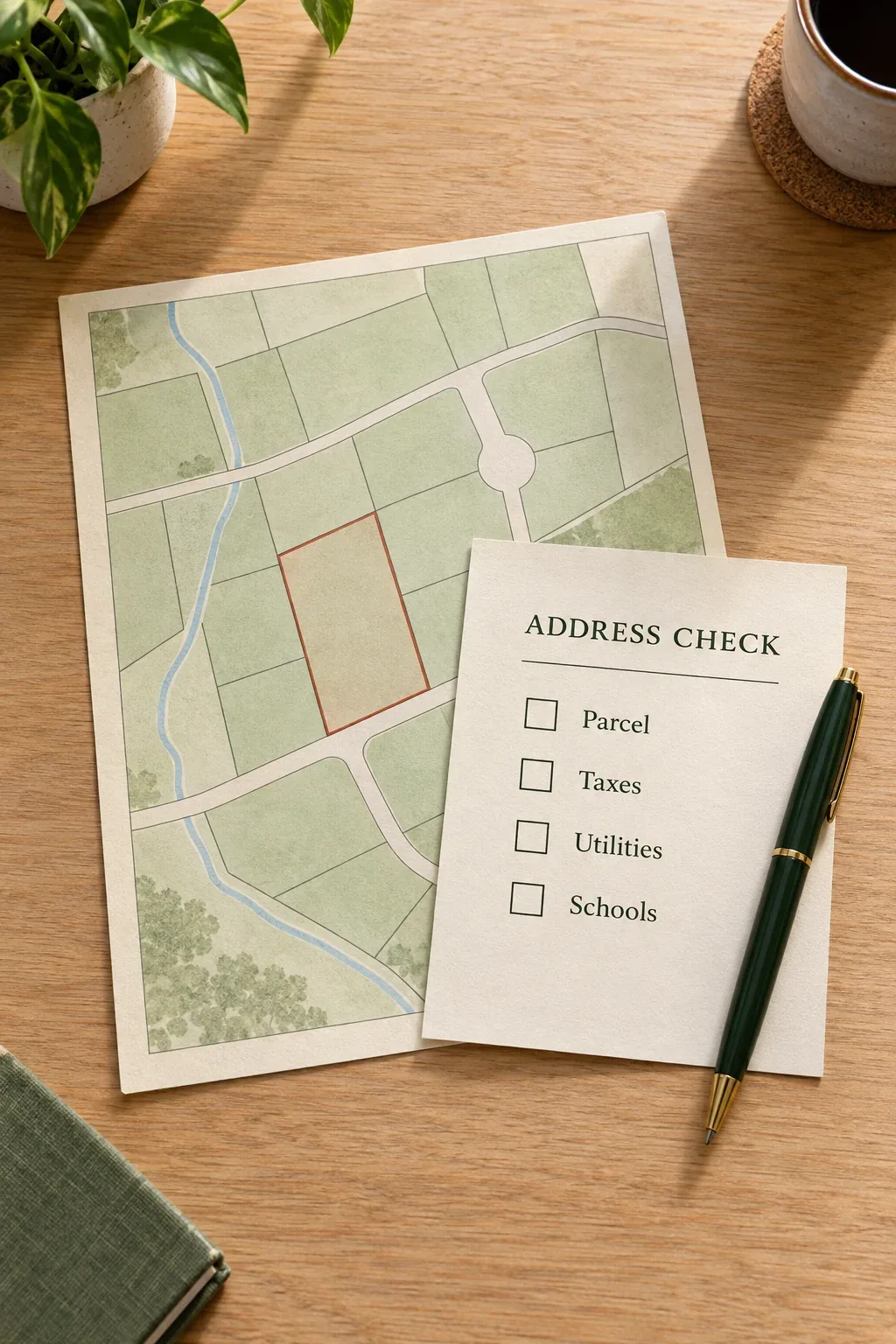
Seven checks for the home you’re considering.
Write down the full street address and the county parcel or map number, and keep both beside you as you open each official tool. When street names, mailing cities, or subdivisions overlap, the parcel number keeps you from pulling up the wrong property. The mailing address won’t tell you who governs or serves the home, so confirm the county, municipality, zoning authority, utility providers, road ownership, and school assignment one at a time. Save what you find and note the date, because records and assignments can change.
1 · Property recordLook up the county property record.
Greenville County’s Real Property Search accepts a street, owner, map number, subdivision, or sales sheet number. From the result, note the owner, map number, tax district, acreage, deed references, and sales history, and open the county property card. Check it all against the listing and the property itself. Everything else on this list starts from that record.
2 · TaxesRun the estimate with the right assumptions.
The seller’s tax bill is not your estimate. A sale generally triggers a new county valuation, and the seller’s legal-residence approval does not carry over. Run the county estimator with your expected purchase price and assessment ratio, then confirm the estimate with the assessor. The estimator does not apply to split-ratio properties.
3 · ZoningCheck the map, then ask for formal verification when it matters.
Inside city limits, start with that city’s planning office. Outside city limits, ask Greenville County which zoning and development rules apply to the parcel. Some unincorporated areas are unzoned; building, septic, subdivision, and private restrictions can still apply.
4 · UtilitiesConfirm each provider instead of assuming one bundle.
The county lists multiple electric, gas, water, and sanitation providers. Availability, connection requirements, sewer or septic, and service boundaries deserve direct confirmation for the property.
Greenville County Utilities Directory
5 · Flood & drainageUse the map as a starting point, not the last word.
The county points buyers to its GIS FEMA layer and Floodplain Administrator for mapped hazard information. Ask about elevation records, drainage, insurance, prior water, and what an inspector or engineer sees on site.
Greenville County Flood Facts (PDF)
6 · Road ownershipFind out who maintains the road.
County, state, city, subdivision, and private roads can have different maintenance paths. Verify ownership, access, recorded easements, and any shared obligations rather than guessing from appearance.
Who Maintains My Road?
7 · School assignmentVerify the exact address directly with the district.
Use Greenville County Schools’ address lookup for current assignment. Do not rely on a portal label, rating site, agent promise, or nearby boundary; assignments and programs can change.
Greenville County Schools Address Lookup
Bring it togetherKeep one address worksheet.
Record the parcel number, tax district, estimate assumptions, zoning result, providers, flood-map check, road owner, school-assignment date, unresolved questions, and the source link for each answer.
Ask Geoff to organize the questions
Official links reviewed August 31, 2026. This guide is specific to Greenville County addresses. Other counties and municipalities use their own records, offices, deadlines, maps, and provider boundaries. Use current records for the home, and have your attorney or the right specialist resolve anything the public tools cannot answer. Considering a vacant parcel? Use the Greenville County buildable lot checklist.